













How matchmoving helps prepare VFX artists at the Academy of Art University
Michael Raphaelovich grew up fascinated by robots, futuristic machines, and anything sci-fi from movies and TV of the 1960s, 70s, and 80s. One of his biggest influences was the Supermarionation series Thunderbirds (1964-1966), where he discovered the work of noted special effects designer Derek Meddings.
“I loved Meddings’ ability to combine illustrations, backdrop paintings, miniature construction, practical effects, and cinematography to create something that felt completely real. His work had a profound impact on me, and played a big part in my decision to pursue animation and visual effects,” says Raphaelovich. “It started with an interest in 2D animation, moved into 3D animation, and ultimately expanded into practical effects and visual storytelling. Looking back, I think my fascination with figuring out how they made it has stayed with me throughout my career. It’s been one heck of a journey, from the world of electronics to working in the VFX industry as a matchmove artist and compositor, to teaching and helping shape the next generation of artists.”
Raphaelovich teaches at the Academy of Art University in San Francisco (where he also earned his Master of Fine Arts in Animation & VFX) and works alongside instructors from ILM, The Third Floor, DreamWorks, and other studios. He also serves as the Online Coordinator for the School of Animation and VFX. The university helps prepare Animation & VFX students with a combination of core skills and StudioX, a real-world film and TV training ground.
His classes include a course in Matchmoving that gives students practical, hands-on experience in live-action 3D camera tracking and Boris FX SynthEyes. “Some students think that the matchmoving process boils down to a single click of a button,” states Raphaelovich. “Once they get into my class, they understand it can be complex. Matchmoving is one of the core pillars of the entire VFX pipeline.”
Raphaelovich believes understanding the matchmove process and SynthEyes is valuable to all VFX artists, not just those pursuing a career as matchmove artists. “Matchmoving teaches you a lot about how cameras and perspective work. That knowledge carries over directly into compositing and 3D,” notes Raphaelovich. “For example, if you’re a compositor, understanding camera tracking and solving allows you to integrate CG elements, set extensions, and other 3D content into a live-action shot much more convincingly. If you’re a 3D artist, knowing how the camera was created from the original plate gives you a much better grasp of how your 3D environment needs to work within that shot.”
He begins by teaching his students the fundamentals of matchmoving through a simplified green-screen shot. Students learn about photogrammetry, parallax, and how to evaluate the camera’s characteristics and statistics within a shot. “I do that so they’ll feel comfortable (and not get overwhelmed) with SynthEyes and understand the matchmoving pipeline and theories,” says Raphaelovich.
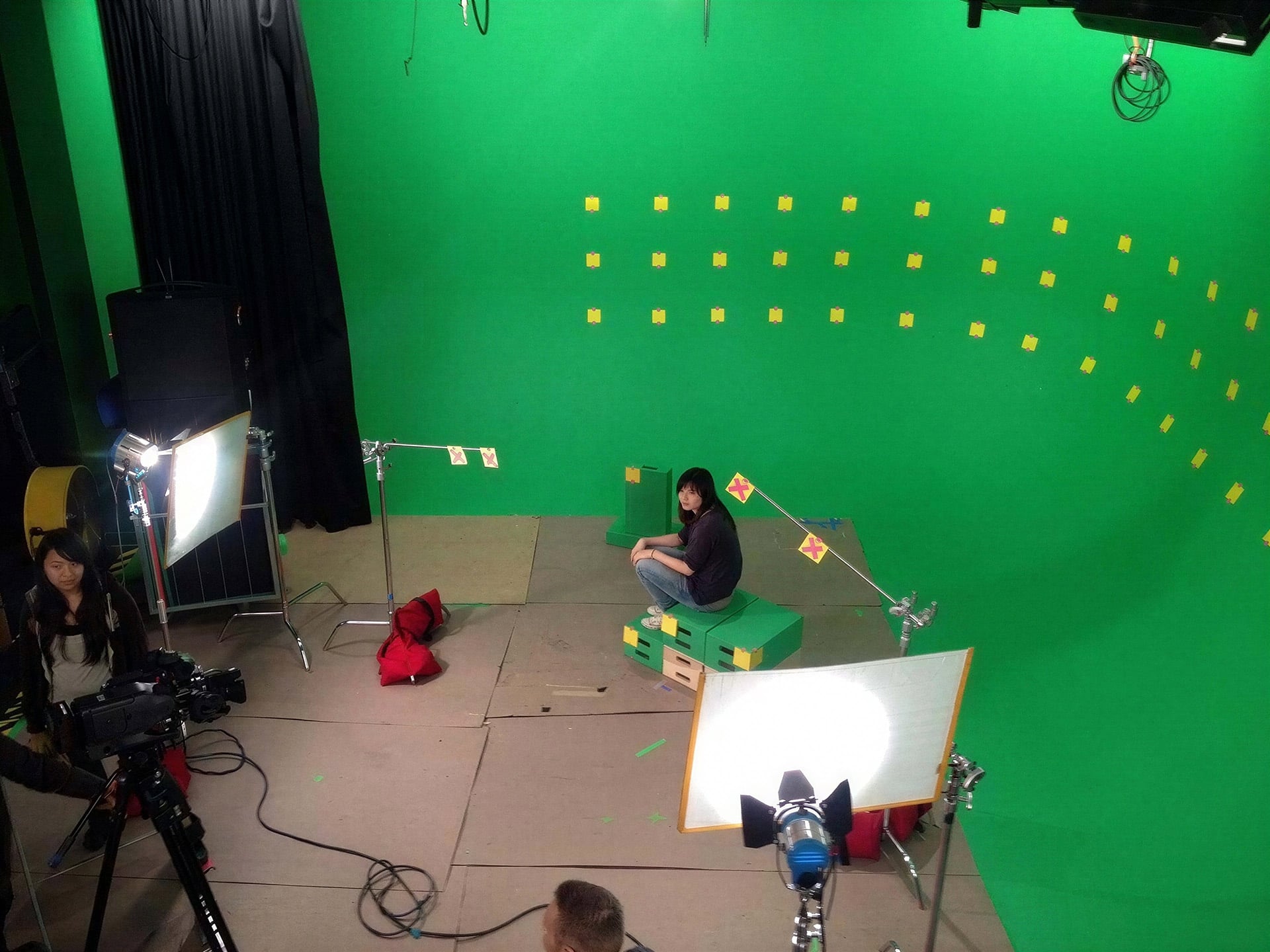
Next, he introduces the SynthEyes interface and explains the workflow and order of operations. He teaches 2D tracking and camera solving, including the difference between the camera’s HPIX error and the tracker’s HPIX error. Once students know how to evaluate and refine a camera solve, he shows them how to export their results to a DCC application like Unreal Engine, Blender, Autodesk Maya, or Cinema 4D to complete the matchmoving process.
“We gradually move onto more complex shots such as nodal pan shots, locked zoomed shots, and zoom shots with a moving camera,” adds Raphaelovich. “We also spend a lot of time on various object tracking shots where the emphasis is mostly on facial tracking and geotracking.”
Raphaelovich uses a variety of shots scanned from 35mm film, consumer DSLR cameras, and professional digital cameras. This lets students practice using image pre-processing tools in SynthEyes and apply LUT info before tracking. He also teaches them how to work with anamorphic shots and handle lens distortions.
“SynthEyes is a matchmoving powerhouse. The university started using it around 2016 or 2017. It made it much easier for students to understand not only the technical process, but also the principles behind matchmoving,” says Raphaelovich. “SynthEyes let us spend more time teaching students how and why matchmoving works, rather than having them struggle with the software. It teaches artists how to analyze footage and solve problems.”
“You’re not just learning which buttons to push; you learn how to look at a shot, understand the camera, recognize perspective and parallax, and determine why something isn’t working,” explains Raphaelovich. “These skills are useful throughout the VFX pipeline. Animation and VFX can be very technical. Sometimes students don’t realize how much they can do until they start putting pieces together. My goal isn’t just to teach them a particular piece of software or specific technique. It’s to teach them and show them how to think like a VFX artist.”
“Ultimately, I hope our students leave my classes with a stronger understanding of the VFX process, a willingness to experiment, and the confidence to keep learning,” ends Raphaelovich. “If they can take those fundamental principles and problem-solving skills and apply them to something I never specifically taught them, then my job is done.”